Information Leaflets
Below you will find information that will help you develop your understanding of the research on teaching reading and phonics, and what this means for practice in the classroom. Bradbury and Wyse (2025) in their peer reviewed open access paper on the dominance of SSP in DfE policy, point out that the claims made by supporters of SSP rely on ‘cherry-picked’ research which circulates and gains authority through repetition, not through settled scientific consensus.
It is important to recognise that very few specific phonics, spelling or reading interventions have been robustly researched, and therefore claims are based on the developers interpretation of general research in the area. SSP (systematic synthetic phonics) research studies that have been published, particularly Johnston and Watson (2005), have been found to have significant methodological flaws which render the findings invalid.
The EEF conducted research on Read Write Inc and found no statistically significant benefit. The effect size was very small indicating negligible effects (read Wyse and Bradbury, 2025, p13).
The leaflets below aim to provide a transparent and fair account of research evidence. Click on the download link to read the leaflet on screen or to download the leaflet to your computer.
Literacy Interventions
Scroll down this page to read about these two interventions which have been researched.
1. The Harberton Reading Programme (Free for schools to download) Reference: McMurray, S., Bower. P., & O’Neill, G. (2023). ‘The importance of simultaneous interconnected processing when learning to read: evidence from a case study school’. This research would not meet the criteria for rigour as it does meet the minimum of 6 of the 8 indicators needed. It was, however, considered to provide a valuable evaluation which was published in, The Journal of the Association of Teachers of Students with Specific Learning Difficulties (Patoss Bulletin). Volume 36, No.1 pages 38-56.
2. The CSP Spelling and Language Programme (can be purchased from www.readwritecompany.com) This research did meet all 8 criteria for rigour (read the ‘What Constitutes Valid Research‘ leaflet). Peer reviewed references: McMurray, S. (2020) “Learning to spell for children 5-8 years of age: the importance of an integrated approach to ensure the development of phonic, orthographic and morphemic knowledge at compatible levels”. Dyslexia, 26:4, 442-458
McMurray, S.(2006) ‘Learning to spell: raising standards in spelling and independent writing’. Support for Learning, Vol 21, No.2 pgs 100-107.
Information Leaflets
What we know about onset and rime
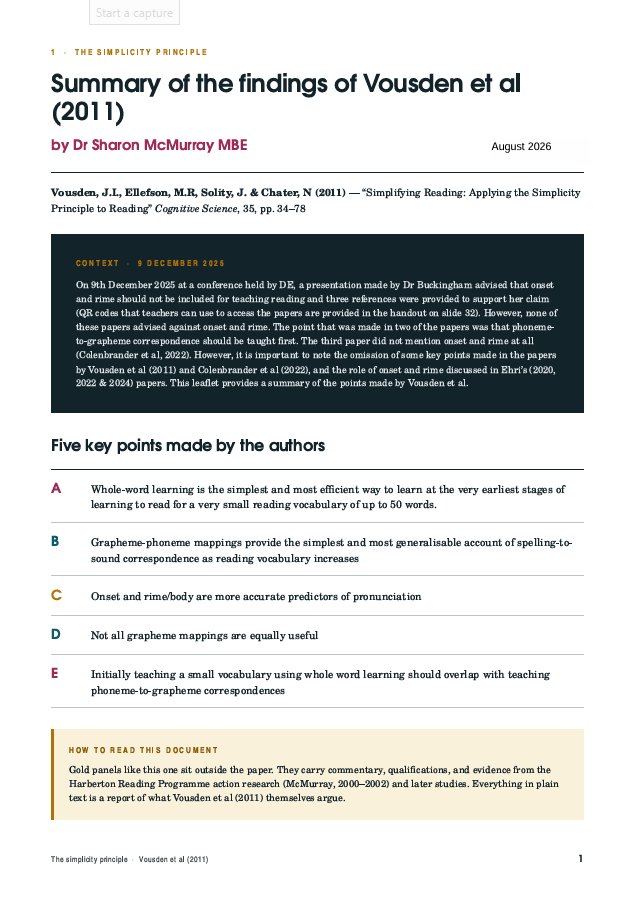
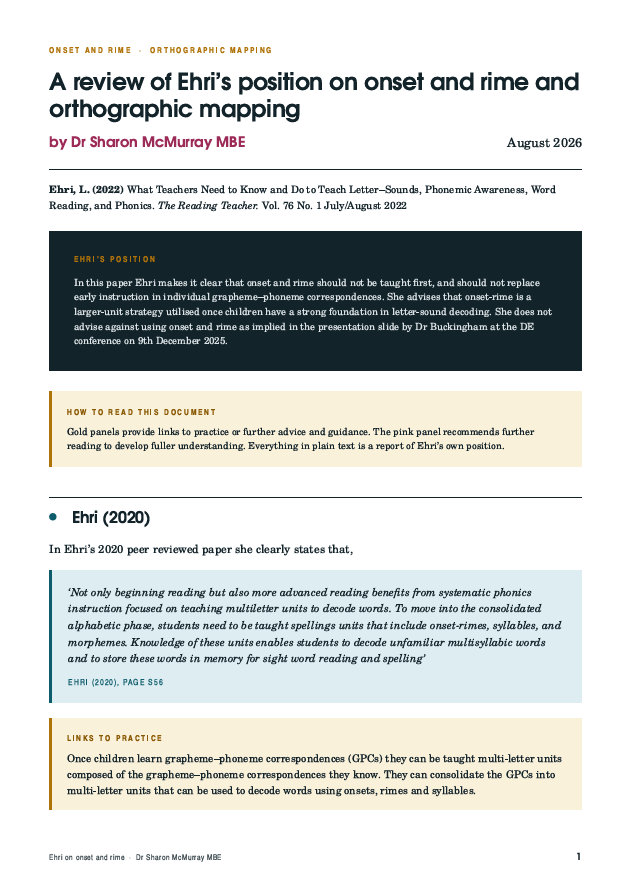
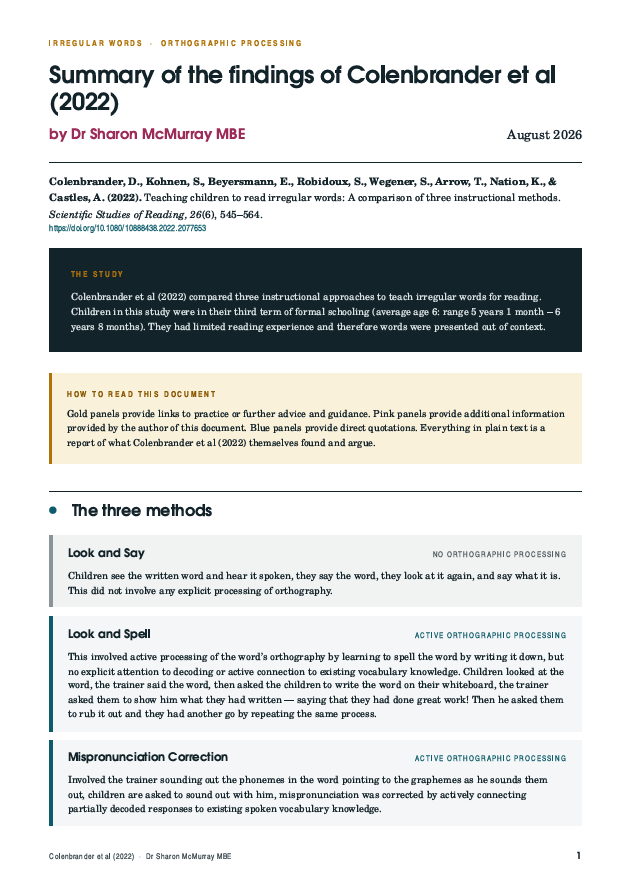
A presenter at the DE conference on 9th December 2025 claimed that onset and rime should not be used for teaching reading and provided QR codes to three papers to support her claim, however these papers did not advise against teaching onset and rime. Two of them advised that phoneme to grapheme correspondence (PGC) should be taught first, not that onset and rime had no role. The third paper did not mention onset and rime at all. Here are summaries of these three papers. From left to right the three summaries are on 1. Vousden et al (2011), 2. Ehri (2020, 2022 & 2024), 3. Colenbrander et al (2022). Click on the download button to read on screen or download.
Understanding morphology and morphemes.
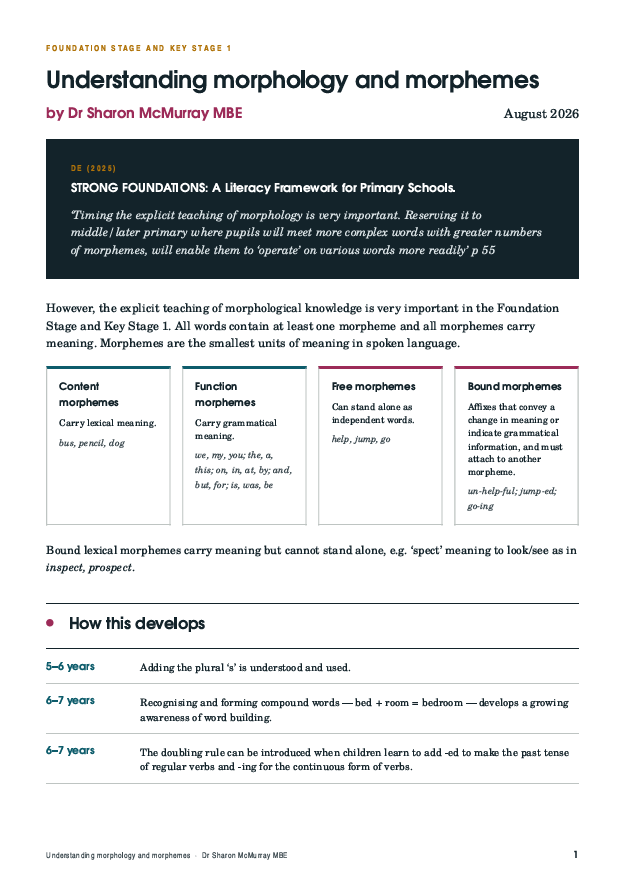
This leaflet provides advice on the importance of the development of morphological and morphemic knowledge in the Foundation Stage and Key Stage One (children 5-8 years of age). It also discusses a misunderstanding about morphemes communicated in a presentation at the DE Conference on 9th December 2025. This leaflet provides guidance to develop teachers’ understanding of morphemes and the development of morphemic knowledge.
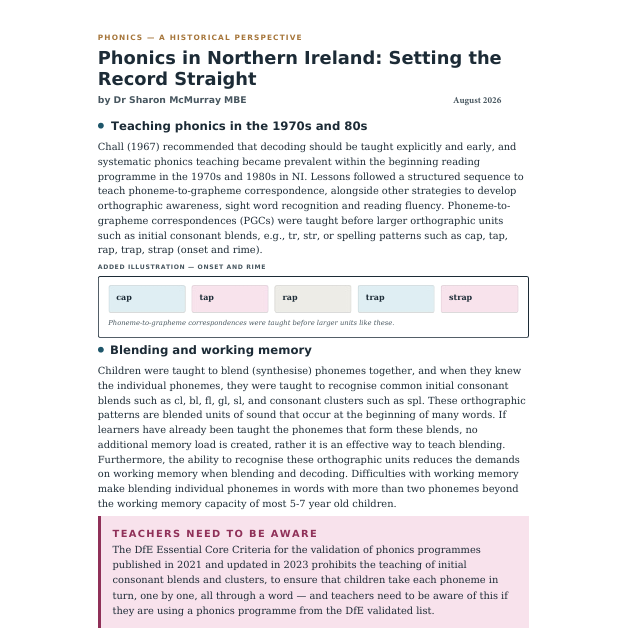
Phonics in Northern Ireland: Setting the Record Straight
in 1967 Chall advanced the case for systematic phonics teaching in the beginning reading programme. By the mid 1970s phonics was taught systematically in many schools in Northern Ireland. Phoneme-to-grapheme correspondence was taught first before teaching larger units of sound. To secure phoneme-to-grapheme knowledge the strategies of analysis (analysing the sounds in words) and synthesis (blending sounds together) were used alongside orthographic activities to develop sight word recognition.
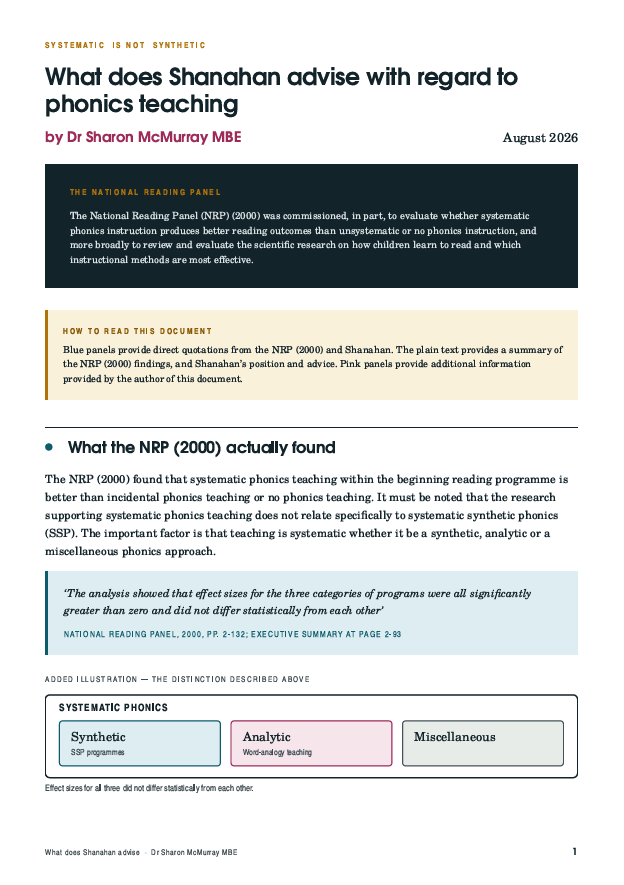
What does Shanahan advise with regard to phonics teaching
Shanahan (2021) advised that ‘The idea of combining synthetic and analytic phonics instruction violates no research, and if done well, may help more kids to succeed.’
In 2026 Shanahan, concerned about the over emphasis on phonics teaching stated, ‘Is there really any reason to believe that teaching phonics first or that only teaching phonics for a year or two is a good idea?…….if you have any interest in the science of reading ……then it’s clear those scorched earth approaches are bad pedagogy.’ Read the leaflet to learn more and see the quotes in full. Shanahan provides a list of supporting references.
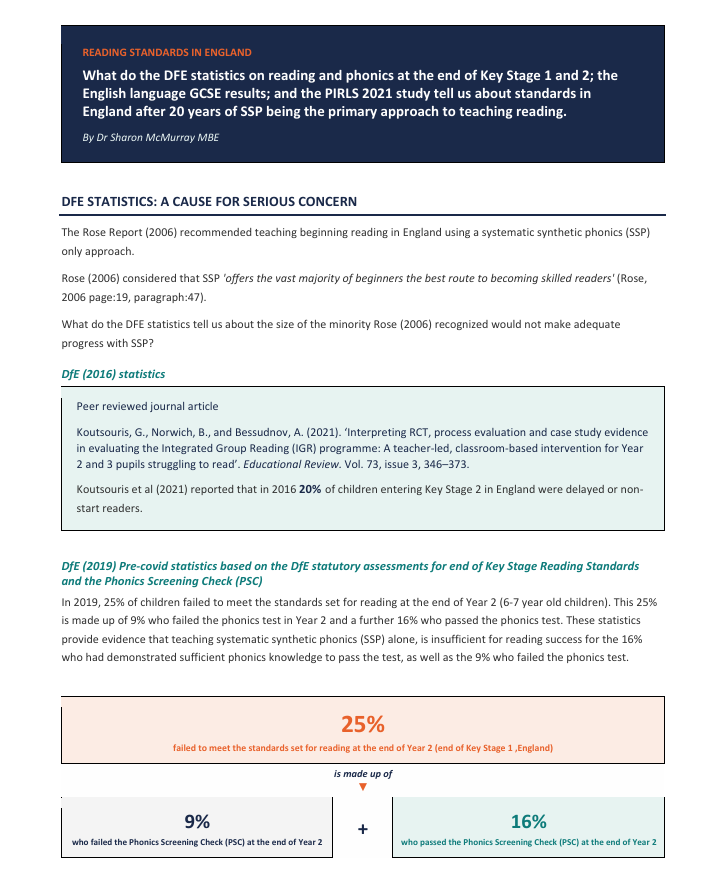
DfE Statistics and Reading Standards
This leaflet discusses the DfE statistics on the reading standards and the Phonics Screening Check at the end of Year 2 in England from 2016-2023. Key Stage 1 in England is from Reception to the end of Year 2 when children are 6-7 year of age. The percentage of children who failed GCSE English Language in England and N. Ireland in 2026 is compared, and issues with the reporting of the PIRLS 2021 findings are highlighted.
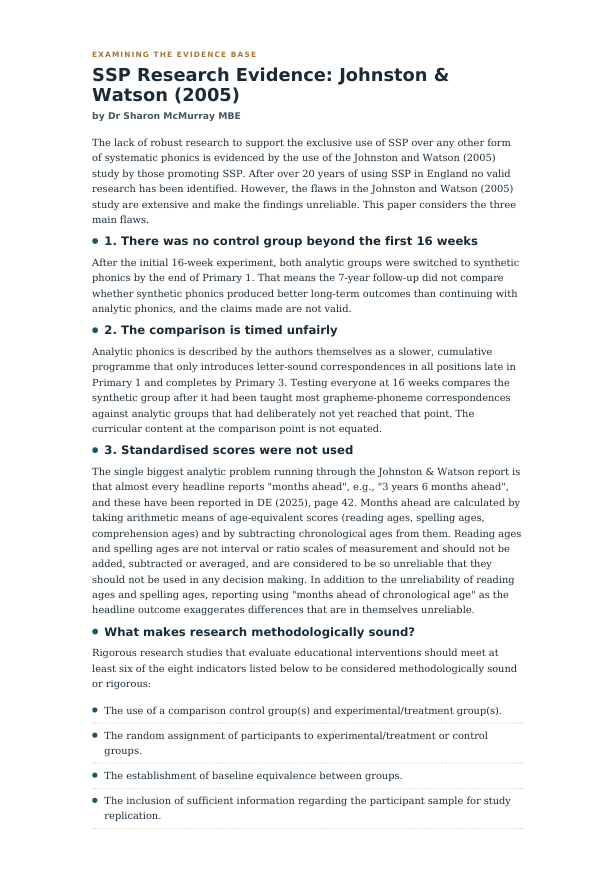
SSP Research Evidence
There is no robust research evidence that has found that systematic synthetic phonics (SSP) is better that any other form of systematic phonics. This is confirmed by the lack of research evidence and the frequently quoted Johnston and Watson (2005) study which has significant methodological flaws. Read the leaflet to understand what these flaws are and why the findings of the study are invalid.
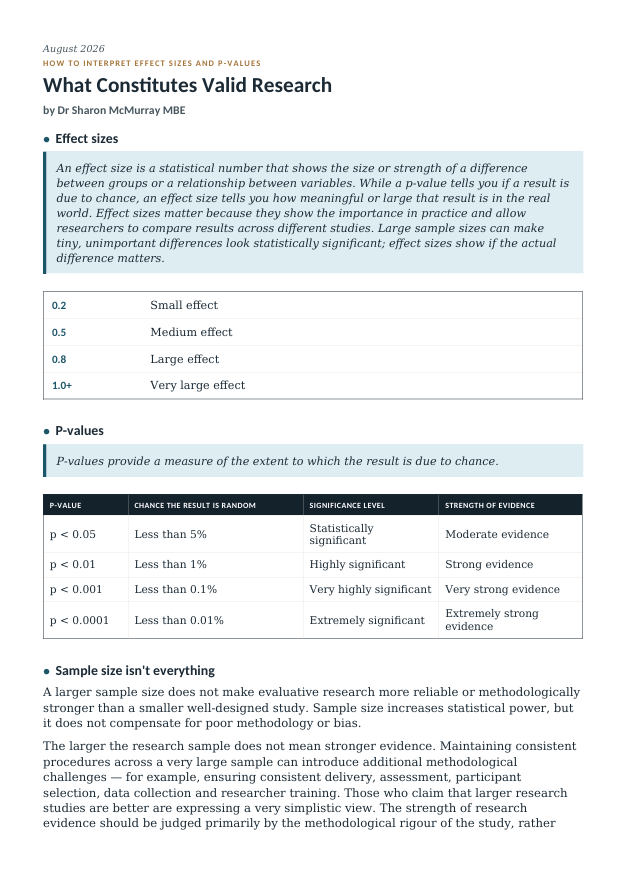
What Constitutes Valid Research
Valid research uses appropriate and rigorous methods to answer a clearly defined research question and produces findings that are supported by the evidence collected. It should minimise bias, use reliable and valid measures, employ an appropriate sample and comparison where relevant, and analyse the data using suitable methods. Conclusions should accurately reflect the results, including the size and uncertainty of any effects, rather than overstating what the evidence demonstrates. Research should also be sufficiently transparent and reproducible to allow its methods, limitations and conclusions to be critically evaluated.
To understand effect sizes and p-values read the attached leaflet. The leaflet also provides and example of robust research.
Evidence of Awareness of Orthographic Issues
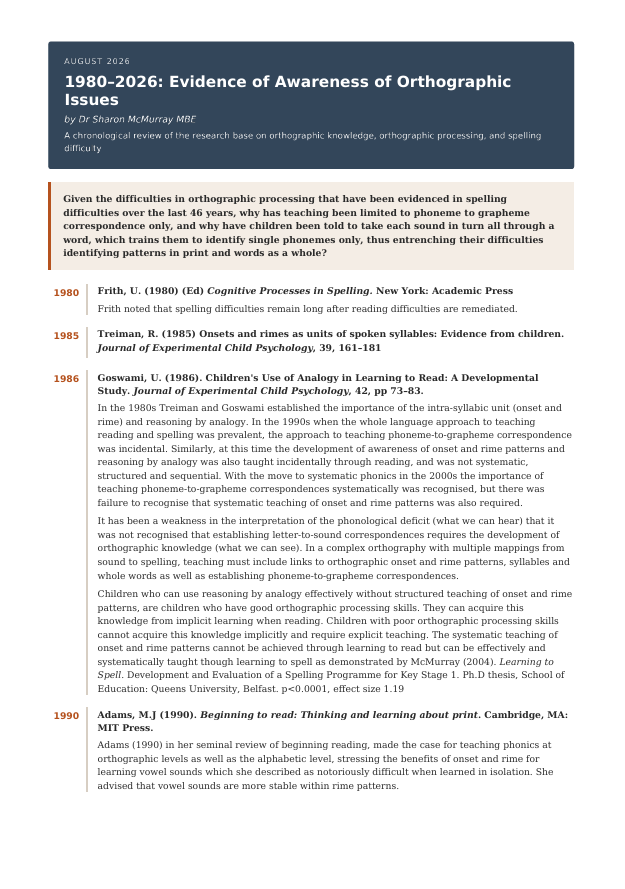
‘Orthographic processing is how you identify and form orthographic units, commit them to memory and retrieve them. It is the cognitive process that enables the detection of letter patterns representing a whole word, patterns within words (onset and rime), syllables, and rules and regularities in print, by attending to each letter whilst also noting letter sequences in parallel as units, thus enabling these orthographic units to be stored in memory. This learning can be acquired implicitly from reading experience. However, children with poor orthographic processing require orthographic mappings to be explicitly taught. McMurray (2004, 2020) provides evidence that spelling is the vehicle that can provide the level of systematic teaching needed.’ (McMurray, Morrow and Bower (2026, p3) – Read Full Research Paper Teaching orthographic mappings requires the systematic teaching of orthographic patterns consisting of more that the one phoneme (onsets, rimes, syllables).
Learning to Spell
This paper considers learning to spell.
Why SSP works for some children and not for others.
SSP is a very narrow approach to phonics teaching which works well in European orthographies where phoneme-to-graphemes correspondences are one to one: one letter – one sound.
Downloadable leaflet coming soon
Please find the link to a video by a parent whose discusses her son’s experience of learning to read using SSP. To protect the identity of the child who is the subject of this video, the mother’s voice has been lowered so that her voice cannot be identified. The child’s name has been removed from the audio, and the mother’s face has been pixelated.
The Harberton Reading (HRP)
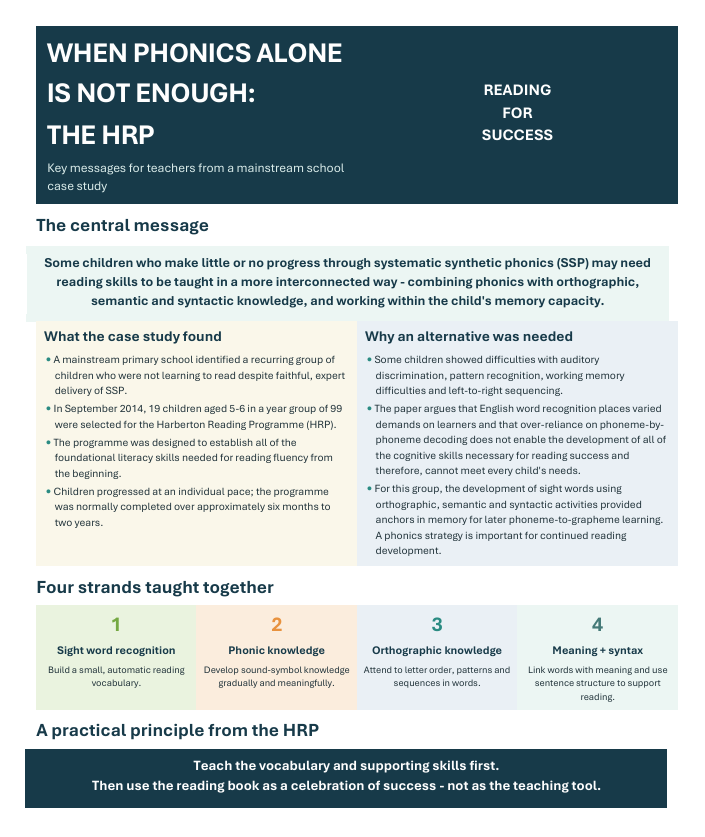
The HRP (McMurray, 2002) was developed for children with moderate learning difficulties (IQ 51-69) who were experiencing extensive difficulties acquiring any literacy skills, but it has also been used in mainstream primary schools with children in the normal range of ability (IQ 70 and over), who struggle to learn to read. The HRP is designed for children who require a very small step-by-step approach and considerable overlearning. The reading vocabulary moves very slowly to take account of limited memory capacity and to allow sufficient overlearning to ensure progress. It is also very important to understand that reading comprehension and reading fluency are essential skills from the very beginning. The reading books are, therefore, the celebration of success, not the teaching tool.
You can download advice and guidance on how to use the HRP here
To order hard copies of the reading books and workbooks, please email Cathy and Claire at printroom-belfast@eani.org.uk. The price lists can be downloaded from here
McMurray, S., Bower. P., & O’Neill, G. (2023). ‘The importance of simultaneous interconnected processing when learning to read: evidence from a case study school’. The Journal of the Association of Teachers of Students with Specific Learning Difficulties (Patoss Bulletin). Volume 36, No.1 pages 38-56
The HRP reading book and workbooks order forms can be accessed using this link. The HRP books can be downloaded from the link below.
https://www.education-ni.gov.uk/publications/harberton-reading-programme
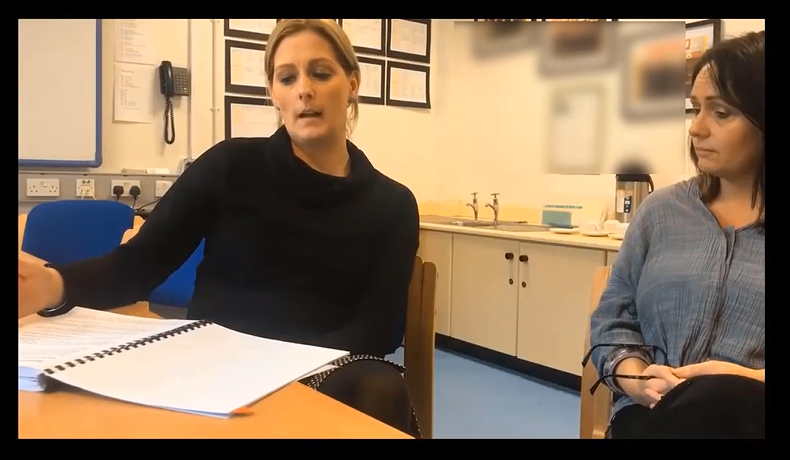
In this video recorded in 2017, the SENCo in a large mainstream primary school discusses the HRP. The HRP was introduced in response to the limited progress made by approximately 20% of 5-6 year-old children who experiencing difficulty learning to read using a systematic synthetic phonics (SSP) approach. The SENCo is discussing the impact of the HRP from 2014 to 2016. The research continued until it was cut short by COVID-19. Final testing was undertaken before school closures. Please note that this school was found to be outstanding on inspection and the literacy coordinator who is also in the video had expertise in the implementation of SSP and was formerly a trainer for systematic synthetic phonics in the Education Authority (EA).
CSP Spelling and Language Programme
NEW
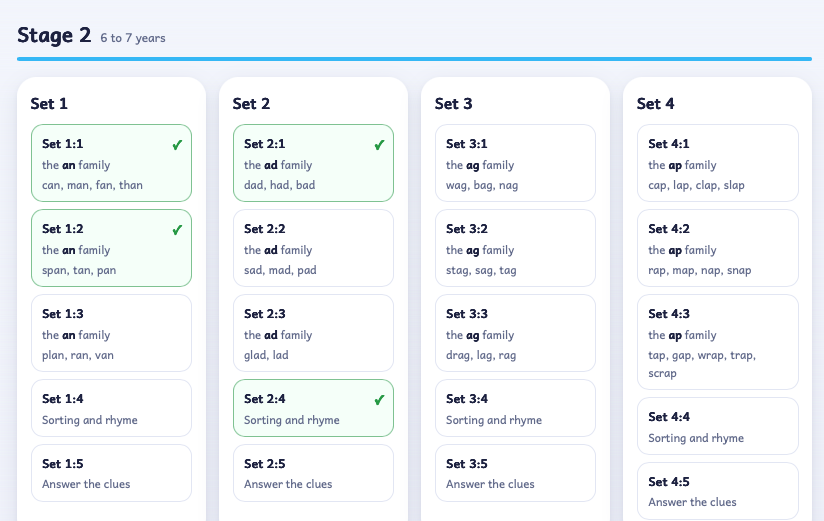
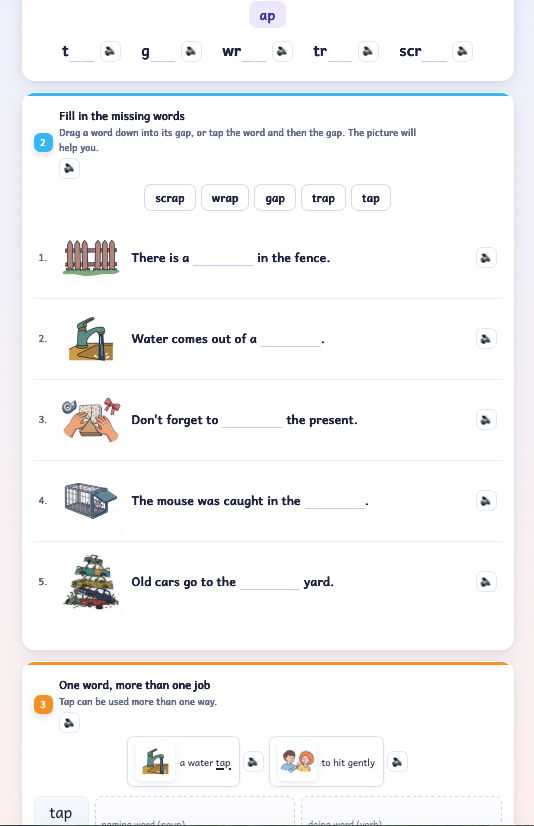
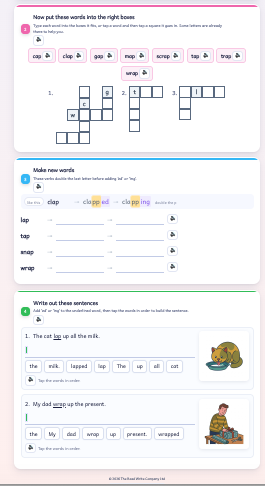
Online interactive teaching activities for stages 1 – 3
In the research, which focused on the implementation of this spelling programme, in addition to teaching children strategies that aid learning, teaching to develop language understanding was a core element. Testing spellings and filling the activity books without the teaching that should precede these activities, will have limited impact, particularly for children who struggle. More recent informal research has found that in today’s busy classrooms it is not realistic to expect teachers to plan the daily lessons needed to teach the language development in the spelling activities, therefore, to reduce teacher workload, all of the planning for day-to-day teaching has been done and is online, in interactive materials designed to maximise teacher-pupil engagement. These are available for stages 1-3 of the programme (Year 2-4).
Research Findings
All of the children in the experimental schools increased their standardised scores from year 2-year 4. The average standardised spelling score was113, almost one standard deviation above the mean. The effect size was 1.19 and the p-value was p<0.0001.
These interactive materials are designed for whole-class teaching, and all children in the class should take part. The language development and repetition built into the activities are beneficial for everyone, not only more able children but also children who find learning more difficult. Children’s receptive vocabulary – the language they understand – is often ahead of their expressive vocabulary, so repeated whole-class teaching gives them valuable time to internalise new language and concepts before they are expected to use them independently in writing.
For this reason, children who find spelling more difficult should use the A Activity Books, which provide an easier level of independent practice while they continue to benefit from the same whole-class teaching but as many children as possible should be on the B activity book.
Both the A and B Activity Book activities should be completed after the related interactive online whole class teaching activities. The workbooks reinforce the learning introduced through the interactive materials.